
What Are DevOps Engineers, Really? Roles, Skills, and How to Become One

Software teams have been fighting the same war for decades: developers ship code, operations breaks it, developers fix it, operations tests it again. That cycle used to take weeks. DevOps exists because that pace became commercially unacceptable Netflix calculated that a single hour of downtime cost them roughly $200,000.
The Problem That Created the Role
Before DevOps became a standard practice, software development ran in two strictly siloed team structures. Developers wrote code, threw it over a metaphorical wall, and the operations team handled testing and deployment. The operations team would send back bug reports and change requests. Developers, now mid-way through the next project, would have to context-switch back to old code. Weeks or months could pass before a project officially closed.
This wasn't anybody's fault. The structure itself caused the delay. Development teams sat idle waiting for feedback. Operations teams fell behind on documentation. The software development lifecycle stretched far beyond what customers expected.
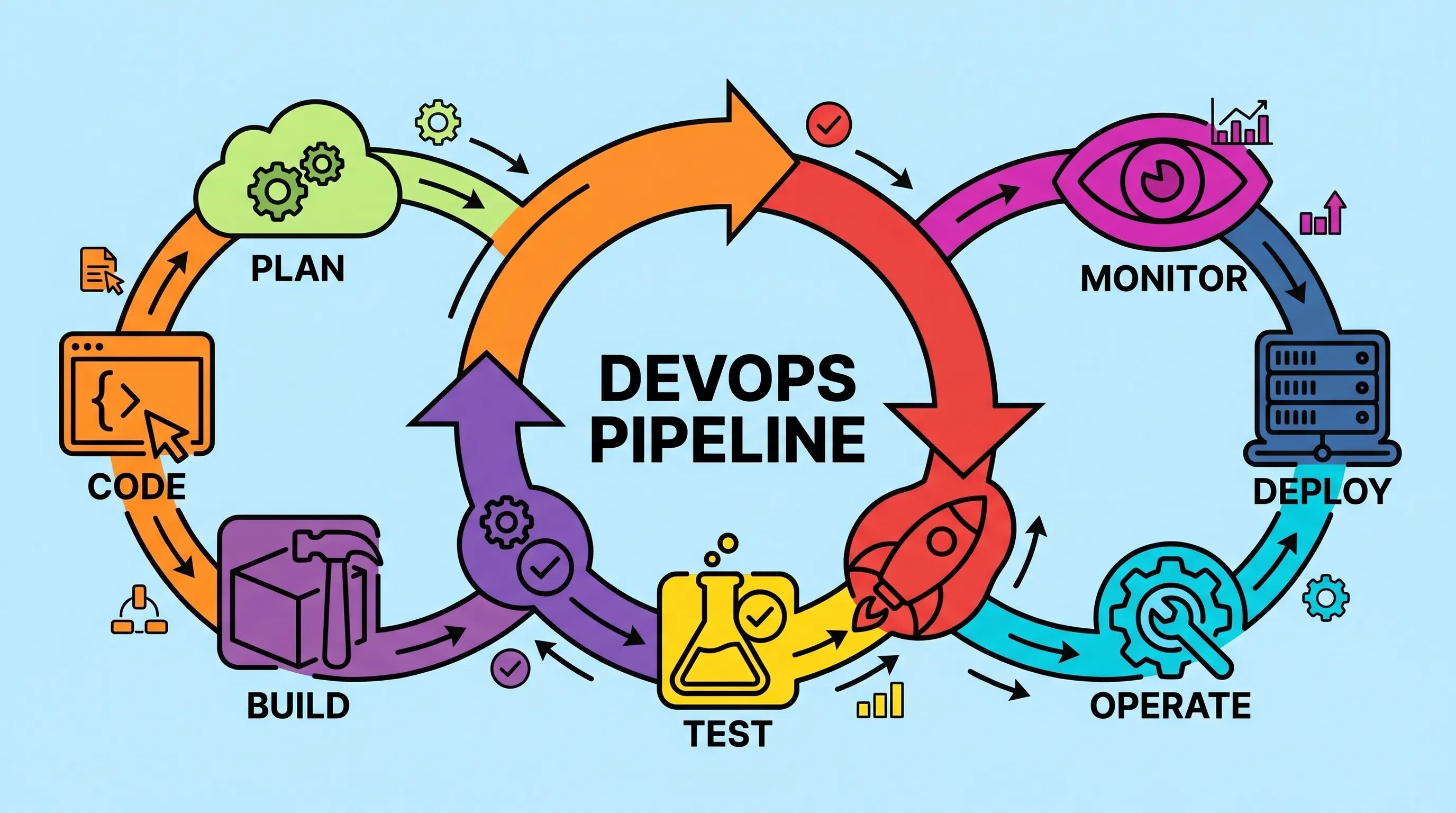
DevOps broke down that wall. The core idea is that development and operations work together across the entire lifecycle of an application, rather than handing off between isolated departments. The DevOps symbol is an infinity loop, which actually captures the intent well: continuous improvement, continuous activity, no hard stops between phases.
Companies that made the shift saw faster delivery, more consistent deployments, and fewer fire-drill releases. Netflix is the clearest example. They adopted DevOps practices and went further, building an internal tool called the "Simian Army" that deliberately injected failures into their infrastructure. The goal was to force engineers to build systems resilient enough to survive chaos in production. That kind of culture only works when development and operations think of themselves as one team.
What Are DevOps Engineers, Exactly?
What is a DevOps engineer, in plain terms? Think of someone who understands both how software is written and how it gets run in production. They are not purely developers, and they are not purely system administrators. The role sits in the overlap, which is also why it is one of the harder roles to hire for.
DevOps engineers design and maintain the infrastructure that developers build on. They automate the steps between writing code and shipping it to users. They monitor systems after deployment and feed that information back into planning. They are, in short, the people responsible for making the software delivery process fast and reliable.
The DevOps philosophy is built around the idea of continuous integration and delivery. Code changes are merged frequently, tested automatically, and deployed in small increments rather than massive quarterly releases. That approach reduces risk and shortens feedback loops significantly.

Daily Responsibilities and What the Job Actually Looks Like
So what does a DevOps engineer do daily? The honest answer is that it varies considerably by company size and maturity, but there are recurring patterns.
A typical day might include reviewing CI/CD pipeline failures from overnight builds, debugging a container that stopped behaving correctly in staging, writing infrastructure as code to provision new cloud resources, and sitting in a planning meeting to understand what the next feature requires from an infrastructure standpoint. Monitoring dashboards are usually open in a browser tab the entire day.
The core DevOps engineer roles and responsibilities tend to cluster around six areas:
Planning and collaboration. Working with product and development teams to understand what is being built and what infrastructure it needs. This happens at the start of every sprint or release cycle.
Version control and branching strategy. Managing how code flows through a Git repository, including merging rules, branch protection, and code review processes. A version control workflow that doesn't have clear rules creates chaos at scale.
Build and test automation. Setting up the pipeline that takes raw code, compiles it, runs tests, and reports back. The automation of testing processes is what keeps a high-velocity team from shipping broken software every other day. Tools like Maven handle build compilation, while Selenium handles automated browser testing.
Deployment and release management. Deciding how and when code moves from staging to production. This includes rollback strategies, feature flags, and zero-downtime deployment techniques. Botched releases are expensive, and this part of the job is where a lot of that risk lives.
Infrastructure management. Configuring servers, cloud environments, networking, and databases. Modern DevOps engineers do this through code rather than clicking around in a console, a practice called infrastructure as code. Configuration management tools like Ansible make this repeatable and auditable.
Monitoring and incident response. Watching production systems for errors, latency spikes, and capacity problems. Monitoring and analytics tools provide the signal; the DevOps engineer interprets it and decides when to escalate.
The Tools That Define the Work
What tools do DevOps engineers use? The ecosystem is large, but most pipelines are built from a recognizable set of components.
Version control: Git is the foundation of almost every software project. Everything starts here.
CI/CD platforms: Jenkins is one of the oldest and most widely used tools for building and testing code automatically. When a developer pushes to Git, Jenkins can trigger a build, run the test suite, and report success or failure within minutes. GitLab has its own built-in CI/CD system that competes directly with Jenkins. CircleCI is popular in cloud-native environments where simplicity and speed matter more than customization.
Build tools: Maven and Gradle are the standard tools for compiling Java-based applications and managing dependencies.
Containerization: Docker packages applications and their dependencies into portable units. This eliminates the "it works on my machine" problem because the container runs the same everywhere.
Orchestration: Kubernetes manages containers at scale. When you have hundreds of containers running across dozens of servers, Kubernetes handles scheduling, scaling, and recovery automatically.
Configuration management: Ansible is used to provision and configure servers consistently. Instead of manually SSH-ing into machines and running commands, you write playbooks that describe the desired state and Ansible applies it.
Monitoring: Nagios has been a staple of IT operations management for years, tracking server health, application uptime, and alerting on failures. More modern stacks layer in tools like Prometheus and Grafana, but Nagios still shows up frequently in enterprise environments.
Automated testing: Selenium drives browser-based testing, simulating real user interactions with a web application to catch front-end bugs before they hit production.
The specific mix depends on the stack, but anyone working in this field will encounter most of these tools at some point.
How DevOps Compares to a Traditional Software Engineering Role
The DevOps engineer vs software engineer distinction is one of the more genuinely blurry areas in tech hiring. Both roles write code. Both care about software quality. The difference is mostly about scope and orientation.
A software engineer is primarily focused on building features. Their measure of success is working functionality delivered to users. They think deeply about algorithms, data structures, and application architecture.
A DevOps engineer is focused on the system that delivers those features. Their measure of success is speed, reliability, and repeatability. They think about infrastructure, automation, and failure modes. Where a software engineer might ask "does this feature work?", a DevOps engineer asks "can we ship this feature safely 10 times a day?"
Is a DevOps engineer a software engineer? Technically, yes, in the sense that strong scripting and programming skills are required. But the job is much closer to site reliability engineering than to product feature development. Google essentially invented the SRE title to describe exactly this kind of hybrid role: someone with the coding skills of a software engineer applied to the reliability problems of operations.
When comparing DevOps engineer vs software engineer salary, DevOps tends to pay slightly higher at mid-level ranges because the role requires both development and system administration skills, which is a harder combination to hire. The technical skills required for a DevOps engineer span multiple disciplines, which is why compensation reflects that breadth.

Getting Into the Field
Breaking into DevOps without a traditional background is genuinely possible, but it takes a deliberate approach. The question of how to gain experience as a DevOps engineer is one that trips people up, because unlike software development, there is no clear "build a portfolio project" analogy.
Here is what actually works:
Start with Linux. Most production infrastructure still runs on Linux, and you cannot work in this field without being comfortable at the command line. Set up a virtual machine, break things, fix them.
Learn one scripting language well. Bash is unavoidable. Python is useful for automation scripts. Pick one and get to the point where you can write a useful script from scratch in under an hour.
Build a basic CI/CD pipeline yourself. Spin up a free GitLab account, write a simple application, and configure a pipeline that runs tests and builds a Docker image on every commit. That hands-on experience is worth more than any certification.
Get comfortable with cloud infrastructure. AWS, Azure, and Google Cloud all have free tiers. Learn how to provision a server, configure networking, and deploy a containerized application.
Study Kubernetes. It is complex, but it is everywhere. Even a surface-level understanding of how it schedules and manages containers makes you significantly more employable.
A computer science degree helps, but this is one of the fields where demonstrated skill through projects and certifications (AWS Certified DevOps Engineer, Certified Kubernetes Administrator) carries real weight with hiring managers.
Career Paths, Specializations, and Salary
The DevOps engineer job outlook is strong by any measure. The shift to cloud infrastructure is still accelerating, and automation demand is not slowing down. Major companies including Amazon, Netflix, Walmart, Facebook, and Adobe have built significant DevOps practices, and the tooling ecosystem continues to expand.
The DevOps engineer salary in the US typically ranges from around $110,000 at the junior level to $160,000 or more at the senior level, with staff-level roles at larger tech companies often exceeding that. Location still matters, though remote work has compressed those ranges somewhat.
DevOps engineering specializations have also become more defined as the field has matured:
Platform engineering focuses on building internal developer platforms, essentially creating tools that other engineers use to deploy and manage their own services.
Cloud infrastructure engineering centers on a specific cloud provider, often AWS or Azure, with deep expertise in managed services, cost optimization, and cloud-native architecture.
Security engineering (DevSecOps) integrates security practices into the CI/CD pipeline itself, so that vulnerability scanning and compliance checks happen automatically rather than as a separate audit process.
Site reliability engineering is the Google-origin model where software engineers own the reliability and performance of production systems with strict error budget disciplines.
Each specialization commands slightly different tooling knowledge, but the core foundation is the same: automate everything you can, monitor everything that matters, and keep development and operations working toward the same goals.
The companies getting the most out of DevOps are the ones that treated it as a cultural shift, not just a tooling upgrade. That distinction matters a lot when you are evaluating whether an employer has actually adopted this approach or just renamed their IT department.
Frequently Asked Questions
What does a DevOps engineer do on a typical day?
Most days involve a mix of pipeline maintenance, infrastructure changes, and collaboration with development teams. In practice, you spend a surprising amount of time debugging CI failures and tracking down why a container is behaving differently in production than in staging. Meetings with product and engineering teams to understand upcoming releases are also a regular part of the schedule. It is not glamorous, but the work is genuinely consequential.
What is a DevOps engineer, and is it a good career choice?
A DevOps engineer bridges software development and IT operations, ensuring that code moves from a developer's machine to production reliably and quickly. As a career, it is well-compensated, in high demand, and constantly evolving. The downside is that the learning never stops. The tooling landscape shifts fast, and staying current requires ongoing effort. If you enjoy solving infrastructure puzzles and value automation, it is a genuinely satisfying field.
How does the DevOps engineer salary compare to a regular software engineer?
At the junior level, salaries are roughly comparable. Mid-level and senior DevOps engineers often earn slightly more than their software engineering counterparts because the role requires both strong coding ability and deep system administration skills. That combination is harder to find, so the market prices it higher. The gap is not dramatic, but it is consistent across most US markets.
Do you need to know how to code to become a DevOps engineer?
Yes, but not at the same depth as a software engineer building features. You need to write scripts, automate processes, and read code well enough to debug pipeline failures and infrastructure issues. Bash and Python cover most of what the role demands. Strong application development experience is helpful but not strictly required to get started.
How do you gain practical experience before landing your first DevOps job?
Build something real. Set up a Git repository, configure a CI/CD pipeline with GitLab or CircleCI, containerize an application with Docker, and deploy it to a cloud provider. Then automate the provisioning of that cloud environment with Ansible. That entire stack, documented clearly in a public repository, tells a hiring manager more about your abilities than a list of certifications. Getting experience as a DevOps engineer is mostly about creating the conditions to practice, not waiting for someone to give you permission to start.
Get CodeTips in your inbox
Free subscription for coding tutorials, best practices, and updates.
More from CodeTips

The Complete DevOps Roadmap: Go from Zero to Engineer in 10 Months
Ten to fourteen months. That's the honest timeline if you study three to five hours a day, don't skip Linux, and resist the urge to jump straight to Kubernetes because it sounds cool on LinkedIn. This DevOps Roadmap is the exact order I'd learn things in if I had to do it again, with real time budgets for each stage and the tools I'd actually install instead of the ones that just look good in a job description.

The DevOps Definition Nobody Actually Explained to You (Until Now)
DevOps gets defined a dozen different ways depending on who's explaining it a culture, a toolchain, a job title. Here's the version that actually held up once I started shipping to production on my own.

The Best CI Server Tools: Honest Picks for Every Dev Team
Picking the wrong CI Server Tools early in a project costs more than people expect — not just in migration time, but in the slow friction of a pipeline that fights your team instead of helping it. I have watched teams rebuild their entire automation setup six months in because they chose something that felt familiar rather than something that fit. This guide is built around what actually matters when you are comparing options: realistic trade-offs, honest limitations, and which tool fits which situation.
What Is a DevOps Pipeline? Stages, Tools, and How to Build One
Most teams don't fail at writing code. They fail at getting it to production reliably, quickly, and without someone staying late to babysit a deployment script. A well-constructed DevOps pipeline is the answer to that specific problem and once you've set one up properly, you'll wonder how you survived the manual version.

CI/CD vs DevOps: What's the Real Difference (And Why It Matters)
Most developers use CI/CD and DevOps interchangeably. They shouldn't. One is a philosophy, the other is a specific, automatable workflow inside that philosophy. Getting that distinction right changes how you build teams, choose tools, and debug failed deployments.
The 12 Best CI CD Tools for DevOps Teams (And How to Pick the Right One)
Most teams ship broken software not because they lack talent, but because they lack the right toolchain. The CI CD tools for DevOps covered here are the ones that have earned their place in real production environments, not just conference talks. This is not a random list of software. It is the actual stack that connects your version control system to running containers in production, with security, observability, and configuration management wired in between.